Kunjal Singhback to desk

Designed to Dispose: UX for a Cleaner Campus

Enhancing Waste Management and Sustainability in hostels through source segregation by implementing Student-Driven Waste Segregation Systems to maximize recyclable recovery, minimize contamination, boost profitability, and safeguard worker health.

This case study explores how I led user research, synthesized findings into actionable insights, and designed a solution tested with real hostel residents.

Timeline

March 2025 - May 2025

Role

End-to-End Product Designer

Skills

Product Research

Product Design

Qualitative UXR

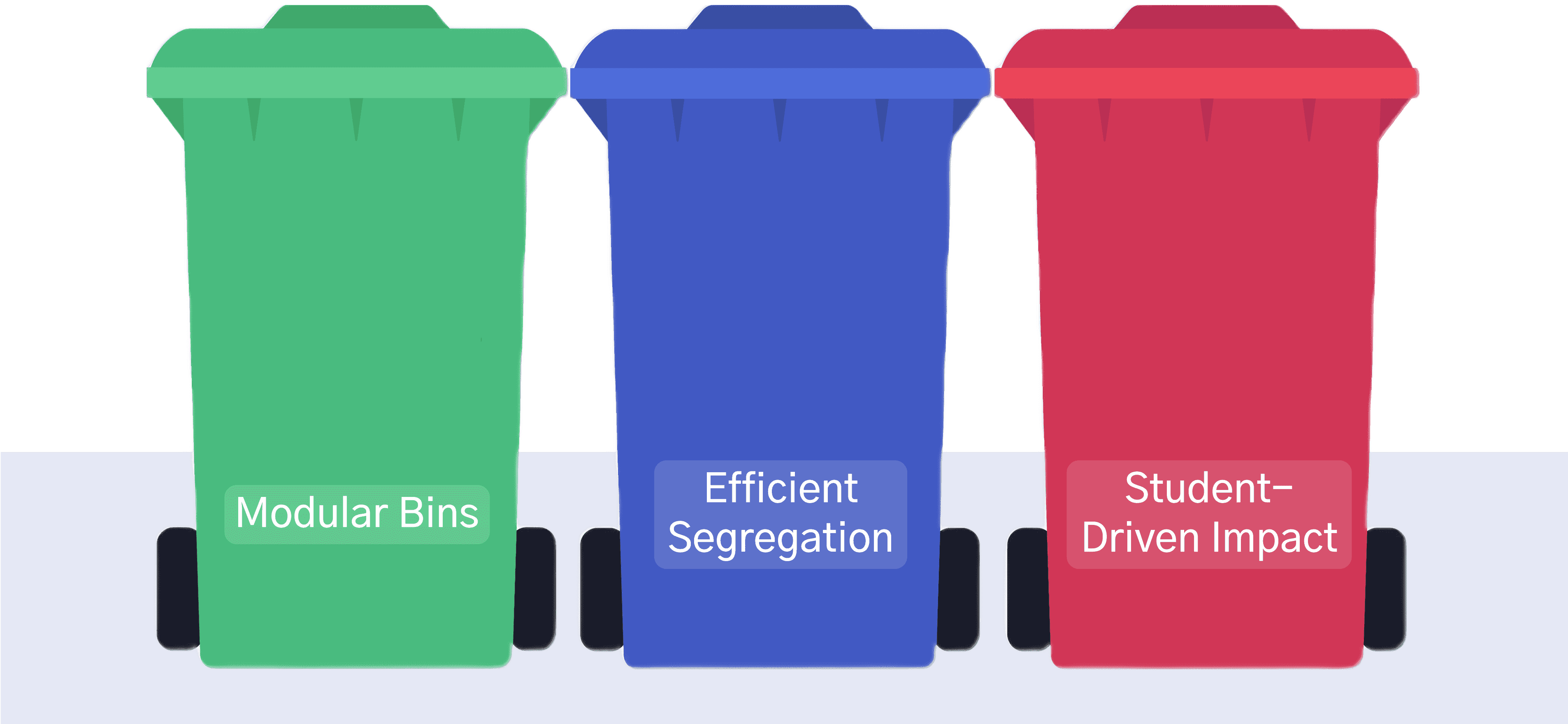
Three wheeled bins labelled Modular Bins, Efficient Segregation and Student-Driven Impact.
Objective
Design a modular waste management system for hostels/universities.
Problem
Hostels lack infrastructure, awareness, and behavior-friendly systems for proper waste segregation.
Insight
Students want to segregate but face space, clarity, and motivation issues. Cleaning staff face physical strain and health risks from mixed waste.
Hypothesis
A modular, ergonomic, and clearly-labeled bin system supported by feedback loops, will increase waste segregation and decrease staff strain.
Exploration
Conducted contextual research and surveys at IIT Patna; created personas, identified primary pain points and tested modular bin variations.
Solution
Designed a horizontal modular bin system for rooms and ergonomic, wheeled floor bins. Integrated behavioural nudges, educational posters, and feedback loops.
Impact
Projected segregation rate increase from 12% to 80%, 12.4 tons CO₂ reduced/year, reduced staff strain by 60–70%, scalable to all university hostels.

The management of waste and sustainability in hostel environments has emerged as a critical concern in the face of growing environmental challenges and resource constraints. This topic was chosen due to its immediate relevance to educational institutions and its potential for significant impact on both local and global scales.

Hostels, as microcosms of larger urban ecosystems, present unique opportunities and challenges in waste management. With India generating over 62 million tonnes of municipal solid waste annually, of which only 20% is processed (CPCB, 2023), the need for effective waste management strategies in high-density living spaces like hostels is paramount.

This project originated as part of the Design Thinking and Innovation course at the IDC School of Design, IIT Bombay, taught by Prof. Ravi Poovaiah.

During the course of the project, I applied a wide range of methods and frameworks from the curriculum—evolving the solution through iterative design and feedback.

Understanding the Waste Ecosystem

To design an effective solution, I first dove deep into understanding the current landscape of hostel waste management.

Mapped out all aspects of waste management in hostels

Helped in determining key aspects for intervention.

Put the hostel waste management ecosystem in perspective, and helped view the bigger picture.

The 5Ws and 1H of the problem space

Key pain points identified through secondary research

  • Only 12-18% of hostels enforce source segregation while generating 42-70 kg of mixed waste daily.
  • Cleaning staff face health risks due to improper waste handling.
  • Limited storage space in hostel rooms hinders individual waste segregation efforts.
  • Students show interest in gamification and tech solutions for sustainability.

After gaining knowledge about the problem space, I mapped out the stakeholders on the basis of their proximity to the whole waste management system.

This helped me prioritize who the solution should empower first — students (behaviour), cleaning staff (ergonomics), and admin (scalability).

Industry Benchmarks

I reviewed benchmark models across India to identify scalable, cost-effective solutions we could adapt for a hostel setting.

SWaCH PuneSWaCH PuneDoor-to-door source segregation18cr saved
Panaji 16-binPanaji 16-binDeep segregation system68% landfill reduced

Understanding the people within the system

While the secondary research helped me uncover systemic inefficiencies, policy gaps, and infrastructure failures in hostel waste management, I realized these were just one side of the story.

I conducted a series of contextual observations in various settings at IIT Patna’s Asima Girls Hostel, which houses over 450 students. The goal was to uncover hidden behavioural patterns, motivations, and frictions that secondary data alone couldn't capture.

Aditi Sharma

20, 2nd year Btech

I want to do the right thing, but there’s no clear way to segregate waste in my room.

Background

  • Often mixes recyclables with general waste due to rush.
  • Orders food delivery 2-3 times a week, adding to unsorted plastic waste.
  • Peer pressure to not be “too fussy” about waste sorting.
  • Lack of awareness about proper waste segregation.
  • Limited storage space in hostel room for multiple waste bins.

Motivations

  • Wants to reduce her carbon footprint.
  • Interested in innovative solutions for sustainability.

Lakshmi Devi

38, Cleaning Staff (Girls Hostel)

Taking the dustbins up and down everyday is a tiring task, and it becomes more difficult after the morning cleaning rounds.

Background

  • Collects waste from rooms and common areas daily.
  • Transports waste to central collection point.
  • Physical strain from carrying heavy, mixed waste bins.
  • Exposure to hazardous materials in unsegregated waste.

Motivations

  • Job security and safety.
  • Better working conditions and protective equipment.

Key pain points validated through primary research

  • Even though some students hesitated to throw plastic waste in the food waste bin in the mess, there was no alternative for them.
  • Cleaning staff (usually middle aged women in girls hostels) spent 2-3 hours each day collecting all waste bins to a singular collection spot, which required 2 members in each block. The bins lack wheels so they had to be dragged or lifted.
  • Limited storage space in hostel rooms hinders individual waste segregation efforts.
  • Most bins were identical or unlabelled, leading to confusion about what goes where — especially for new or non-eco-conscious students.
  • There were no posters, color codes, or orientation info on waste disposal protocols. New residents remained unaware of best practices.

Designing for users closest to the problem

After collecting qualitative and quantitative data about the problem space, users and common challenges, I redefined the problem statement.

Enhancing Waste Management and Sustainability in hostels through source segregation by implementing Scalable Student-Driven Waste Segregation Systems to maximise recyclable recovery, minimize contamination, boost profitability, and safeguard worker health.

Ideation

I wanted to create a scalable system targeting student behaviour and also employing circular economy principle that takes effect from the moment waste is generated.

Key opportunities identified for intervention

Primary: Waste disposal (1st and 2nd level)

Secondary: Feedback loop for hostel administration and students

Tertiary: Waste generation

Initial Sketches

Keeping the stakeholder behaviour and primary intervention opportunities in mind I sketched out a solution to target source segregation and cleaning staff’s safety and comfort.

I came up with three different designs covering common and personal dustbins to aid segregation and ergonomics

Floor and Mess Dustbins:

  • Features multiple color-coded bins mounted on a sturdy, wheeled metal stand.
  • Enables easy transportation by cleaning staff, reducing manual lifting and physical strain.
  • Ideal for floor-level waste collection and centralised movement to collection points.

Vertical Attached Variation:

  • Bins are stacked vertically, optimizing space in smaller rooms or tight corners.
  • Maintains clear separation of waste streams while minimizing the floor footprint.
  • Ensures all bins are easily reachable, enhancing accessibility for students.

Room Dustbins:

  • Rolling Stand Variation (smaller version of floor dustbins)
  • Modular Attached Variation:
    • Bins are designed to be attached side-by-side in a compact, horizontal arrangement.
    • Allows users to keep all waste categories together in one accessible location within a room.
    • Bins can be detached and positioned separately as needed, supporting personalized waste sorting habits.

Survey Results

The survey was conducted with 10 hostel residents across demographics and the modular, horizontally attached variation was preferred for rooms for its flexibility and efficient use of space.

The rolling floor dustbins were preferred by the cleaning staff as it doesn’t require 2 members to clear a floor and they are able to use this time to get a much-needed break.

9 out of 10 participants prefer the personalisation in the modular bins
66% voted against the vertically stacked dustbin
100% prefer the use of wheel and pedals

Creating a solution that lasts

To create a sustainable cycle of positive actions, acting upon the secondary and tertiary intervention opportunities is important.

I created a feedback loop - at the end of each month, every hostel receives a report from the waste management facility detailing metrics such as total waste recycled, extent of segregation, and cleaning staff comfort levels. This report is shared both via email with the student body and on hostel bulletin boards to ensure transparency.

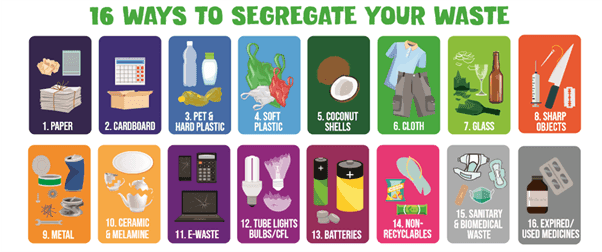
To reinforce daily behaviour, visual guides including segregation instructions and bin usage posters are placed above all dustbins in the mess and on every floor.

By implementing these interventions, the system not only supports efficient waste processing, but also cultivates long-term habits and motivation among students.

Visualising the solution

Here is a visual guide for my solution, that gives a clear understanding of the effectiveness and scalability.

Future scope and learning

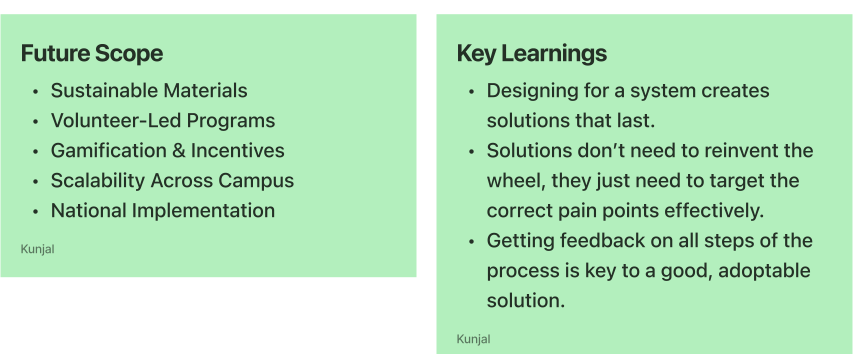
Although I did not create a high-fidelity 3D prototype, this project allowed me to clearly visualize and map out a behavioral, ergonomic, and systemic solution that addresses the core challenges of hostel waste management.